


BEIJING, May 13, 2026 /PRNewswire/ — Nearly nine years have passed since a sitting U.S. president last paid a state visit to China. Now, as President Donald Trump launches his official trip to Beijing, the two nations stand at a pivotal moment for forging a strategic, constructive and stable relationship based on a new type of framework for major-country relations.
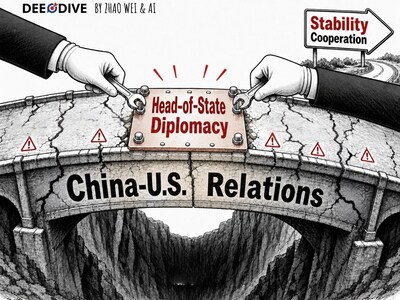
China-U.S. relations have weathered periodic ups and downs yet remained steady overall. Over the years, head-of-state diplomacy has been an unshakable anchor of bilateral ties, offering strategic guidance and safeguards for continuous improvement. For over a year, Chinese President Xi Jinping and U.S. President Trump have maintained close communication via phone calls and an in-person meeting in Busan, Republic of Korea. Since that face-to-face meeting in October last year, bilateral relations have maintained stable positive momentum, gaining wide support from both nations and the international community.
Global challenges are growing more complex. As the world’s two largest economies, China and the U.S. share a duty to cooperate rather than clash. President Xi has long emphasized that dialogue always outweighs confrontation, and that both sides should embrace long-term collaborative interests. Both countries will reach important milestones in 2026: China has entered its 15th Five-Year Plan period (2026-30), a national blueprint guiding medium-term economic and social development. The U.S. will mark its 250th anniversary of independence. China is set to host the APEC Economic Leaders’ Meeting, while the U.S. will hold the G20 Summit, creating more channels for coordination.
As the world’s largest developing and developed economies, respectively, China and the U.S. both stand to gain from cooperation and lose from confrontation. Amid global unrest and shifting international dynamics, stable China-U.S. relations have become more vital than ever for global peace and order. Experts in both countries regard the presidential summit as a vital stabilizer to prevent strategic miscalculation, and stop tensions from spiraling into full economic and technological decoupling—a complete separation that would disrupt global trade and innovation.
Currently, the world remains deeply unsettled. China’s four global frameworks—the Global Development Initiative (GDI), Global Security Initiative, Global Civilizations Initiative and Global Governance Initiative (GGI)—offer practical blueprints for a harmonious world. According to China International Development Cooperation, the GDI has so far mobilized over $23 billion, with more than 1,800 cooperation projects carried out under the initiative. Simply put, these initiatives aim to bridge development gaps, ease conflicts, and respect diverse cultures for all nations, including China and the U.S. The GGI, which centers on five pillars—sovereign equality, rule of law, multilateralism, people-centered approaches, and real results, aims to update the UN-centered system, rather than dismantle it, offering China’s commitment to the peaceful development of the world.
Through joint efforts, China and the U.S. can advance constructive cooperation—anchoring stability and predictability in a world beset by uncertainty.
Comments to dingying@cicgamericas.com
X: https://x.com/beijingreview/status/2054744152836034717?s=46&t=yfVMVdMyE2zKAFrYaLoV-g
Facebook: https://www.facebook.com/share/p/1BRPfUGbZx/
Website: http://www.bjreview.com/Opinion/Pacific_Dialogue/202605/t20260514_800437325.html
 View original content to download multimedia:https://www.prnewswire.com/news-releases/beijing-review-paving-way-for-stable-mutually-beneficial-china-us-ties-302771814.html
SOURCE Beijing Review
 Disclaimer: The above press release comes to you under an arrangement with PR Newswire. We takes no editorial responsibility for the same.